Tuesday, August 2, 2011

Issue Eight: The Mermaid's Bladder

NOAA TEACHER AT SEA
CATHRINE PRENOT FOX
ONBOARD NOAA SHIP OSCAR DYSON
JULY 24 – AUGUST 14, 2011


Mission:  Walleye Pollock Survey
Location:  Kodiak, Alaska
Date:  August 2, 2011

Weather Data from the Bridge
True Wind Speed:  na
Air Temperature:  14.0° C dry/12.4° C wet
Air Pressure: na
Clouds, Fog and Rain
Latitude:  57.44° N, Longitude:  152.31° W
Ship heading:  n/a
(Limited data, as ship is in port) 


Personal Log:
If you follow the links on the side-bar for the NOAA fleet map, you will notice that yes, indeed, we are still in Kodiak on the Coast Guard Base.  My father informs me that if you go to google maps, you can zoom in and actually see the ship!  I'd say I would wave to you, but I haven't really spent a great deal of time onboard with so much to see and explore.  Today is an exception, with 100% humidity (code for pouring) and I have been busily finishing two cartoons; one of which follows.

http://www.kwakiutl.bc.ca/assets/bullkelp.jpg
I have always been fascinated by members of the taxonomic kingdom protista: a group of diverse organisms united by the fact that they don't fit into any of the other kingdoms (plants, animal, fungi and two bacteria).  Protists also have eukaryotic cells, or cells with a nucleus and specialized organelles.  I can wax poetic for an hour about diatoms, extol the virtues of Spirogyra and Volvox (an of how my students should name bands after them), and get excited about cillates like Stentor or Blepharisma.  Imagine my delight at finding Bull Kelp, Nerocystis luetkeana, washed up on shore during a walk along Women's Bay.  


I know.  It may be difficult for you to imagine it.  Instead, try reading Issue 8: The Mermaid's Bladder and watching a short relaxing video... ...then come back and we'll have a little chat.  (Cartoon citations: 1, 2 and 3)
Adventures in a Blue World.  Issue 8.  Cathrine Prenot Fox, 2011
Bull kelp is pretty amazing.  Since it is an annual, it grows from a single spore to a ginormous height in one year--sometimes growing as much as 10 inches per day.  Indigenous peoples have made use of the stem for nets, harpoons, and fishing lines; the hollow float can be dried to store water or oil, and the stem and blades can be eaten.  Pretty impressive, for a lowly protist.


Until our next adventure, 
Cat


 p.s. Many thanks to my sister Laura for doing Adventures in a Blue World video research for me.  We don't have a great deal of bandwidth on ship, and are not allowed to pig out on available cyberspace with video watching (plus, it would be abysmally slow). xo LJ!

Monday, August 1, 2011

Issue Seven: Eight arms, three hearts, three brains

NOAA TEACHER AT SEA
CATHRINE PRENOT FOX
ONBOARD NOAA SHIP OSCAR DYSON
JULY 24 – AUGUST 14, 2011


Mission:  Walleye Pollock Survey
Location:  Kodiak, Alaska
Date:  July 31, 2011

Weather Data from the Bridge
True Wind Speed:  na
Air Temperature:  17.9° C dry/13.8° C wet
Air Pressure: na
Partly Cloudy
Latitude:  57.44° N, Longitude:  152.31° W
Ship heading:  n/a
(Limited data, as ship is in port) 

Lupine, Pasagshak Beach
Personal Log: 
Sometimes, science research is messy.  Now might be one of those times.  We are in Kodiak awaiting repairs to the rescue boat and the arrival of a deck hand before we can get underway.  Everyone is doing everything they can to get us moving, but if you haven't noticed yet, Kodiak is remote.  The up side of this delay?  Kodiak is a beautiful, interesting place to explore, and I have taken full advantage of this opportunity.   


Staci DeSchryver, Teacher at Sea
The head of our scientific team, Dr. Chris Wilson, introduced Staci (the other Teacher at Sea) and me to the director of the  Kodiak Fisheries Research Center, Dr. Robert Foy.  Bob took us on an amazing backroom tour of the Center, complete with two story aquariums, open tanks (Staci calls them underwater petting zoos), huge lab spaces and experiments in progress.  One of the coolest organisms was a Giant Pacific Octopus.  We got to play with it.  Read that last sentence again, will you?  We got to play with it.  Amazing, eh?


Adventures in a Blue World.  Issue 7.  Cathrine Prenot Fox, 2011
In honor of Enteroctopus dofleini, I present to you Issue 7: Eight arms, three hearts, three brains.  (Cartoon citations 1, 2 and 3)  Check out Issue 7 and some excellent video and let me know if your impressions of this invertebrate have changed at all.  


Fossil Beach. Kodiak, AK

The wildlife viewing both underwater and on land has been spectacular.  We drove down to a remote place called Fossil Beach around the bluff from Pasagshak Bay on the southeast side of the island and encountered wild horses on the way there, (spotted?) seals cruising the beach and three Kodiak brown bears on the way home (!).  Two of the bears were smaller juveniles fishing at river crossings; the third was a huge adult that ran out in front of the car.  The hump on its back was the level of the roof.  Seriously?  This bear was the size of a small pony.  Other wildlife abound: otters, pigeon guillemots and jellyfish swim around our ship, black oystercatchers and fox parade on shore and bald eagles sail overhead.  So, while we are all anxious to "get fishin," we are still learning a ton and having an excellent time.  


I'll leave you with a photo of one of the bears: a "tiny" juvenile fishing in the Olds River in Kalsin Bay.  Oh, and if you have any ideas for interesting ocean organisms for Adventures in a Blue World, drop me a line.  I'm working on two really cool ones that I'll deliver in the next several days, but then will be looking for new inspiration. 


Until our next adventure, 
Teacher on Land, Cat Fox


p.s.  To clear up a common misconception: Grizzly and Brown Bears are the same species, Ursus arctos.  Inland bears are usually called Grizzlies, coastal are browns.  
p.p.s.  A few folks have sent me some great new links on octopuses.  Here is a video showing octopus camouflage and an interesting  article on an octopus from Germany that picked the winners in the World Cup last summer.
Kodiak Brown Bear.  Kodiak, AK.


Wednesday, July 27, 2011

Issue Six: Alaska, impossibly big and impossibly green

NOAA TEACHER AT SEA
CATHRINE PRENOT FOX
ONBOARD NOAA SHIP OSCAR DYSON
JULY 24 – AUGUST 14, 2011


Mission:  Walleye Pollock Survey
Location:  Kodiak, Alaska
Date:  July 27, 2011

Weather Data from the Bridge
True Wind Speed:  na
Air Temperature:  14° C dry/12° C wet
Air Pressure: na
Overcast
Latitude:  57.44° N, Longitude:  152.31° W
Ship heading:  n/a
(Limited data, as ship is in port)

Scientific Log: 
I've received an in-depth tour of the ship and labs, and I am starting to piece together how the "Acoustic Trawl Survey" works.  Basically, NOAA is responsible for monitoring the populations of walleye pollock and accomplishes this task in several ways.  The acoustic trawl survey is one part of how this is done.


Net Reels 
The science team identifies particular transect areas in the Gulf of Alaska.  The ship travels to that area, then transmits acoustic signals about once per second as it travels along each transect.  The returning echo gives scientists an initial measurement of the abundance of organisms in the water below the ship.  Just "listening," however, is not enough.  We also have to sample populations physically to determine the ages, sizes, and species of the organisms.  The ship trawls for these additional data.  


A trawl is a large net towed behind the ship to catch fish and other organisms.  The individuals (of all species) in the catch are identified and counted.  Cameras (three) are mounted inside the back of the trawl (codend) to collect images as they pass through the trawl.    From this larger catch, a sample of the walleye pollock (about 300 individuals) are dissected to determine sex, diet, measured (length and weight) for size and aged by looking at (yes) their ear bones or otoliths. I'll cover all of this in depth once I have been able to do it and see it in action, but that is the gist.  


Personal Log:
I think first impressions are important.  Alaska?  Alaska is impossibly big and impossibly green.  Too big, perhaps to describe with common adjectives.  It took me about two days of travel from the 4-Corners to make my way up here:  a Beechcraft 1900 from Cortez to Denver, then flights from Denver to Seattle and Seattle to Anchorage.  I spent the night in Anchorage and wandered the city at midnight... ...not that you can tell that it was so late from the pictures.  

The next morning I took off from Anchorage and met up with the crew and scientific party onboard the Oscar Dyson in Kodiak, an island the size of Connecticut in the Gulf of Alaska.  
Adventures in a Blue World. Issue 6.  Cathrine Prenot Fox, 2011.


As for how 'impossibly green' Alaska is, I was thinking about the reasons Georgia O'Keeffe gave for moving from New York City to New Mexico in 1949.  She said (and I paraphrase) that she wanted to use more vibrant colors in her palette of paints than just green.  Ms. O'Keeffe would have it rough here in Alaska: greens, greys and blues abound.  Adventures in a Blue World Issue 6 may not convince you of the colors of Alaska, but I hope it gives you a grasp of its size.   
Kodiak, Alaska dock
Coast Guard dock, Oscar Dyson


I've already settled in to the ship and my stateroom.  My stateroom is small but comfortable, and I share it with a woman who is part of the scientific NOAA team.  Interestingly, she worked for the same professor at the Rocky Mountain Biological Laboratory in Gothic, Colorado as an undergraduate that I did.  Very Small World.  


We are docked in Kodiak for a few more days than anticipated: we are awaiting the arrival of another deck-hand, and there are a few repairs that need to be made to the ship.  Once we get started, I will be working the 4am-4pm shift, and taking part in whatever science is taking place.  In the meantime, I get to 'nose around' Kodiak, go for hikes and runs, check out museums (see below), and eat as many salmonberries as I can stuff into my mouth.  


Until our next adventure, 
Cat


Friday, July 22, 2011

Issue Five: Cuteness factor of eleven

NOAA TEACHER AT SEA
CATHRINE PRENOT FOX
ONBOARD NOAA SHIP OSCAR DYSON
JULY 24 – AUGUST 14, 2011

 
Personal Log:
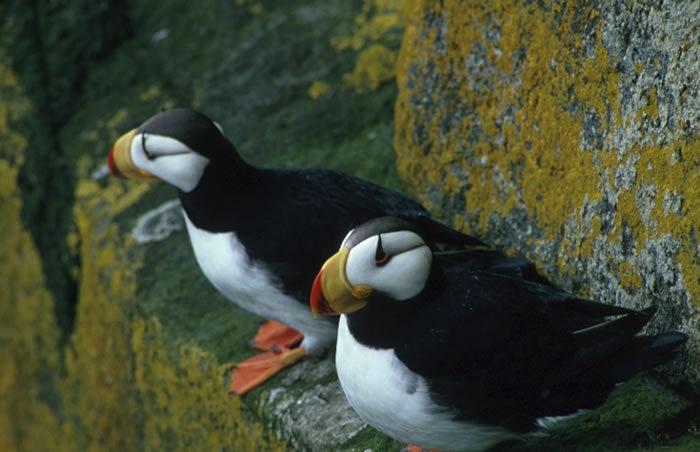
I'd like to say that it was for purely scientific reasons that the next cartoon in the series features the Puffins of Alaska.  The truth be told, it was their deliciously cute little squishy bodies, their Buddha-like serenity and comical attempts at movement above water.  Not sold yet?  One viewing of the live "Puffin Cam" on Seal Island National Wildlife Refuge and you will be enraptured...

http://projectpuffin.org/images/PuffinsWithCam07.jpg
These are Atlantic Puffins, and while marvelously interesting, are not native to Alaskan waters.  Instead, I am excited to introduce you to the Tufted Puffin (Fratercula cirrhata) and Horned Puffin (F. corniculata), both residents of the air, land and water surrounding the Oscar Dyson.

www.birdinginformation.com/wp-content/gallery/cache/1790__400x400_tufted-puffin-breeding-4a.jpg


www.nhptv.org/natureworks/hornedpuffin.htm

Adventures in a Blue World.  Issue 5.  Cathrine Prenot Fox, 2011
See what I mean?  How can you resist them?  For more on these chubby dumplings of the sea, check out issue five of Adventures in a Blue World:  Cuteness factor of eleven (Cartoon citations 1, 2, and 3).

Until our next adventure,
Cat

Friday, July 15, 2011

Issue Four: A Nautical Primer

NOAA TEACHER AT SEA
CATHRINE PRENOT FOX
ONBOARD NOAA SHIP OSCAR DYSON
JULY 24 – AUGUST 14, 2011

 
Personal Log:
I worked for many summers in construction doing finish work on log-cabin homes.  My coworkers would have had months of detention from me if they had been in my class but, over time, I assimilated.  A few weeks before summer vacation ended, I put a jar on the kitchen counter.  If words escaped my lips that wouldn't be quite...appropriate coming from a school teacher, I paid a tax into the jar.  By the time school began, I was back to using the King's English, and some local charity was a bit richer.  
www.omao.noaa.gov/08_dyson_orca.html

I realized soon after I found out I'd be a Teacher at Sea that I was going to need to do some serious work on my nautical language.  It wasn't that I wanted to swear like a sailor per se, but that I needed to call things by their proper names.  Case in point: I am traveling on a ship, not a boat.  (For those of you not in the maritime community, please recognize that calling a ship a boat is akin to swearing.)  I hope that Issue 4 of Adventures in a Blue World may help others not make as many faux pas as I have, with help from A Nautical Primer:  (cartoon citations: 1 and 2)
Adventures in a Blue World.  Issue 4.  Cathrine Prenot Fox, 2011
(Depending on your source, many common idioms have a nautical history.  A few claim that "dressed to the nines" or "the whole nine yards" refers to a ship coming into port with all sails unfurled (although there is, to be sure, considerable debate).)

Whether or not you need to brush up on some simple terms, take some time to explore the website for the ship the Oscar Dyson.  It was fascinating to me how much is packed into a little over 200ft. 


Until our next adventure, 
Cat


Sunday, July 10, 2011

Issue Three: Why are we seasick?

NOAA TEACHER AT SEA
CATHRINE PRENOT FOX
ONBOARD NOAA SHIP OSCAR DYSON
JULY 24 – AUGUST 14, 2011

Personal Log
Every year on my birthday my Nana sent me a card with a $20 bill tucked into it.  Her written instructions were: "do something nice."  Without fail, the entire sum would be spent on ride tickets at the Dutchess County Fair for the roller coaster, tea-cup spin, high swings, pirate ship and the 'round-up' ride (an old fashioned gravitron).  Evidently, I assumed that she meant "do something nice (for yourself)."

I still love a good stomach dropping roller-coaster ride but as a scientist I have grown curious about the biology of balance.  Why is it that I occasionally suffer from motion sickness but other times can eat funnel cakes, ride the spinniest amusement park ride and have no fear of the aftermath?   Furthermore, when I was on a ship in high seas of the North Atlantic Ocean around the Hebrides (west of Scotland) I didn't even have a stomach quiver... ...once I put foot on shore though, my body decided that land was moving alarmingly.

The most frequent question of all Teacher at Sea Blogs that I have read in the past two months is a variation on this: "Are you seasick?"    Since the word 'Nausea' stems from the Greek 'naus,' or ship, I think it seems very appropriate to address this question through Issue 3: Why are we seasick?  (Again, if you click on the cartoon it should open in another window so you can read it more easily and magnify.) 

Adventures in a Blue World.  Issue 3.  Cathrine Prenot Fox, 2011.
Motion sickness in general seems to arise from the brain's inability to resolve a conflict between the senses of balance.  When input from the eyes, fine motor muscles, skin receptors and the organs of the inner ear don't add up, your brain assumes that something must be adversely effecting the body.  A cascade of events takes place: cold sweats, the pyloric valve of the stomach closes up, letting no food pass to the intestines, dizziness, vertigo, nausea and sometimes...well, you know.  The most common theory is that the brain thinks the body's discordant messages mean that it is hallucinating and has ingested a poison.  Response?  Get rid of it.

Techniques to help resolve your brain's conflict include napping and snacking (which I happen to be excellent at!), avoiding greasy or acidic foods and simply keeping a visual reference point on the horizon.  Although I am bringing some OTC meds in case I get desperate, I have also stocked up on ginger chew candy.  Ginger loosens up the pyloric valve, letting your stomach empty out, and making it less likely that you will "chum the waters."

Commander Richard Behn, 1979.  NOAA.
If the Oscar Dyson gets into waves anything like these onboard the Discoverer in the Bering Sea in 1979 (yes, I know, very unlikely), I don't know if ginger and snacking will do me any good.

Whatever the result, at least I will have something to ponder if I have to take a few trips to the rail.

Until our next adventure,
Cat

Wednesday, July 6, 2011

Issue Two: NOAA?

NOAA TEACHER AT SEA
CATHRINE PRENOT FOX
ONBOARD NOAA SHIP OSCAR DYSON
JULY 24 – AUGUST 14, 2011

Personal Log
As my date of departure nears, I have been having a lot of conversations about what the National Oceanic and Atmospheric Administration (NOAA) is, what I will be doing in Alaska, and what a Teacher at Sea does.  The best way to answer your questions is through another cartoon.


Adventures in a Blue World.  Issue 2.  Cathrine Prenot Fox, 2011
The official title of my mission is "NOAA's Alaska Fisheries Science Center for their Walleye Pollock Survey aboard NOAA Ship Oscar Dyson."  (Say that ten times fast.)  The Teacher at Sea goals also align with some of NOAA's Enterprise Objectives: 1) An engaged and educated public with an improved capacity to make scientifically informed environmental decisions; and 2) Diverse and constantly evolving capabilities in NOAA's workforce.

To read more about NOAA, check out their website:  http://www.noaa.gov/  A peruse through just the headlines will teach you about 'elusive basking sharks,' why evenings are getting warmer, what to expect for solar flares in 2013 (a lot!) and how NOAA satellites are tracking wildfires across the west.  Pretty interesting.  

In the meantime, I am packing up for the trip of a lifetime: warm layers, my trusty binocs, and, of course, some anti-seasickness precautions, which I'll be discussing in my next cartoon.

Until our next adventure,
Cat