Friday, September 30, 2011

Issue Fourteen: Late Night Television

NOAA TEACHER AT SEA
CATHRINE PRENOT FOX
NOAA SHIP OSCAR DYSON
JULY 24 – AUGUST 14, 2011


Personal Log:
Late night television=brain torture.  I think late night t.v. might be designed to shrink brain neurons: shopping networks, exercise shows, self help and reality programs.  Some studies have even linked watching late night t.v. to obesity and sleep deprivation.  I'd rather stab myself with a butter knife than be trapped on a couch watching a self help guru in the middle of the night...  ...On the Oscar Dyson, though?  You couldn't drag me away from the 4:30 a.m. screen, as it shows a live feed of the floor of the ocean 100 meters below us.

The camera drops were just one part of the night-time research aboard the Oscar Dyson.  Dr. Jodi Pirtle, a post doctoral research associate at the University of New Hampshire Center for Coastal and Ocean Mapping, utilized her lab hours to explore and document "untrawlable" portions of our survey area.  Rocky bottoms, pinnacles, shelves... ...all make it difficult to drop a net down to get an accurate reading of groundfish diversity and abundance without destroying the net.

Throughout the night the ship maneuvers tight turns to provide high resolution acoustic signals of the bottom.  My fellow Teacher at Sea, Staci DeSchryver, describes the ship's movements as akin to "lawn mowing."  My father, watching the NOAA ship tracker online after one of these sessions, asked if the captain had had one too many cocktails (absolutely not, by the way).  These turns, in addition to making me sleep like a baby, provide an overlapping and highly accurate map of the ocean floor.  Below is a multibeam image of a seamount (underwater mountain) mapped during the 2004 Gulf of Alaska Seamount Expedition.  
"In this multibeam image of Ely Seamount, the caldera (aka the Crater of Doom) is visible at the apex of the seamount." Image courtesy of Jason Chaytor, NOAA
Adventures in a Blue World.  Issue 14.  Cathrine Prenot Fox, 2011.
After a night of intensive napping, I mean mapping, I go on shift at 4am.  I know I have mentioned this before, but I have the best job in the world: my first task in the morning is helping with camera deployment.  I am sure you will agree after checking out Issue 14 that several camera drops equal the best Late Night T.V. I have ever seen (Cartoon citations 1 and 2). 

Until our next adventure,
Cat


Retrieving the camera. Snakehead.
Not to be redundant, but the best job ever. 

Sunday, September 18, 2011

Issue Thirteen: Walleye Pollock Status Page

NOAA TEACHER AT SEA
CATHRINE PRENOT FOX
NOAA SHIP OSCAR DYSON
JULY 24 – AUGUST 14, 2011


Personal Log:
I have not always had the best morals when it came to eating seafood.  I discovered the joys of sushi in San Francisco after I graduated college.  There was one place that I would frequent so often that the sushi chefs would would create something for me when I walked through the door.  I later learned from Ruth Reichl in her book Garlic and Sapphires that the phrase I was looking for was "Omakase." Literally: I am in your hands.  In their capable hands I tried unagi (eel), hon maguro (bluefin tuna), and hamachi (yellowtail) for the first time.  And I fell in love.

A few years later, a friend mentioned to me that I might want to moderate my adoration of some fish.  Never one to take someone else's word, I did my own research.  I read, with growing horror, that my delicious eel farms were not sustainable, and that bluefin tuna was declining worldwide.  Evidently, there were so many others that shared my love of the cool simple taste of hon maguro that we were loving these and other species to death.  I know, you probably don't want to take my word for it.  Do your own research and then come back: FishWatch and SeaFoodWatch.

Back?  Did you see that Yellowfin tuna are being sustainably harvested?  Yes, me too.  One order of hamachi sashimi, please.   


Adventures in a Blue World.  Issue 13.  Cathrine Prenot Fox, 2011.
What is my point with all of this?  I want to show you what data are used to make these determinations about sustainability.  I assure you, it is not random or haphazard.  In fact, the purpose of my time in Alaska was to provide data to fisheries managers (composed of teams of fishermen, scientists, and officials) to let them make educated decisions on the health of walleye pollock populations in the Gulf of Alaska.  What data do we collect?  How do we know what the fish are doing, and how many there are?  It isn't an easy job... there is no Walleye Pollock Facebook Status Page that you can just check... (Cartoon citations 1, 2, and 3).  You have to get dirty and do some real science. 

Until our next adventure, Cat

Walleye Pollock age classes.

p.s. Although my "real job" has severely impacted the amount of time I have to cartoon, I am still working on at least two more (and up to seven, if I find a way to get a hold of a Time-Turner like Hermione Granger) cartoons.  Thank you for being patient! 


Friday, August 12, 2011

Issue Twelve: Better than any alarm clock

NOAA TEACHER AT SEA
CATHRINE PRENOT FOX
ONBOARD NOAA SHIP OSCAR DYSON
JULY 24 – AUGUST 14, 2011


Mission:  Walleye Pollock Survey
Location:  Kodiak, Alaska
Date:  August 11, 2011

Weather Data from the Bridge
Latitude: 57deg 22.630N,  Longitude:  152.02° W
Air Temperature:  13.6° C
Water temperature: 9.0° C
Wind Speed/Direction: 12kn/240°
Barometric Pressure: 1020.1
Partly cloudy (5%) and sun


Science Log: 
Stern of the Oscar Dyson
Somewhere back in my family history there must have been a fishmonger, because I've been channeling something or someone.  The entire process of watching the acoustic footprint of the ocean under the ship, deciding where to physically sample (trawl) populations, and then seeing and processing the fish that live 100 meters or more below us?  Fascinating.  Add to this camera drops to get snapshots of the ocean floor (more amazing footage this morning), and interesting 'Methot' plankton tows to sample what is available for the fish to eat and give a more accurate and complete picture?  How many adjectives can I use?  

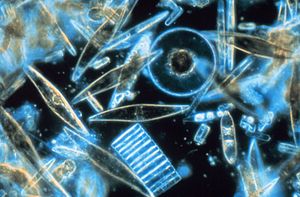
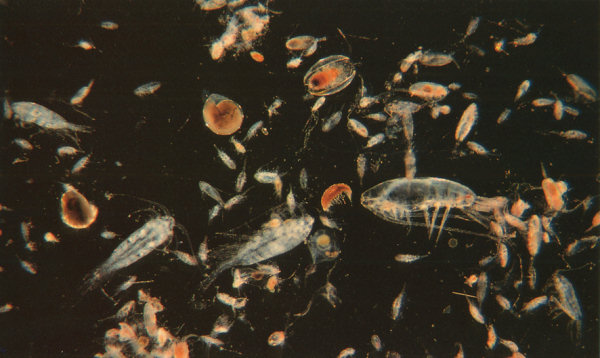
Before we dive too far into the depths, let me explain/refresh what plankton are. Plankton are any drifting organisms that inhabit the water columns of bodies of water.  In fact, their name derives from the Greek for "wanderer," and it would be helpful if you thought of them as drifters in the current...from deep in the ocean to up on the surface.  They are generally broken down into plant-like-photosynthesizing plankton (phytoplankton) and animal-like plankton (zooplankton).  Let me show you:


en.wikipedia.org
Phytoplankton are "photosynthesizing microscopic organisms that inhabit the upper sunlit layer of almost alloceans and bodies of water" (wikipedia).  If you have taken biology or forensics with me, I have described some of them ad nauseam: diatoms?  Those organisms that are in every body of water on the planet?  Ah, yes.  I can see it all coming back to you. 


http://desalalternatives.org/wp-content/uploads/2010/10/zooplankton.jp
Zooplankton encompass a diverse range of macro and microscopic animals.  They generally eat the phytoplankton or one another.  Examples include krill, copepods, jellyfish, and amphipods.


In the great food web of life, other organisms eat the zooplankton.  Among them was a pod of 50+ Humpback whales in the Barnabas Trough off of Kodiak Island.  They were exciting enough that I went from being sound asleep to dressed and on the bridge in less than five minutes.  Issue 12, Humpback Whales: Better than any alarm clock I have ever known delves into these organisms (Cartoon citations 1, 2, 3 and 4).
Adventures in a Blue World, Issue 12.  Cathrine Prenot Fox, 2011


Our chief survey technician, Kathy Hough, took a lot of photos the following day as we traveled from Barnabas Trough to Alitak Bay.  The three photos that follow and descriptions are courtesy of Kathy. 
Whale tail: Individual humpback whales can be identified by the black/white pattern on the ventral side of the fluke (tail).  The pattern is like a human's fingerprint, unique to one animal.
There is evidence of three whales in the photo above: the closest whale's rostrum (blow hole) is visible.  The second whale is diving and you can see the peduncle (the stocky part of the tail before the fluke).  The glassy area in the back of the photo is evidence of a recent dive and is called a "footprint."  
This Humpback was last seen in this area in 2004, and has not been seen since.  The white marks on its fluke are from a killer whale attack!  Kathy emailled photos of the whales to observers, and they were able to identify individuals!
All hands on deck... 100+ Humpback Whales.  Darin and Staci.
Our team of scientists sample plankton using a Methot net, which is fine mesh and captures macroscopic organisms.  We sample plankton for the same reason that we physically trawl for fish: we need to make certain what we are "hearing" is what is down there, with a focus on the types and sizes of the plankton.  Additionally, knowledge about what and where plankton populations are will help with modeling the entire ecosystem.  If you know where the food lives, its abundance and composition, by extension you have a much greater understanding of the predators, both pollock and whale.    

(If you get a chance, check out this video about how whales hunt with bubble nets; fascinating!)


Personal Log
Bowditch
I try to spend time on the bridge every morning before breakfast.  I bring up a cup of tea and watch the horizon lighten until the sun pushes its way up above the lingering clouds.  This morning, I saw the green flash for the first time.  The green flash is not a superhero.  It is not a myth.  It is not a sailor's fish tail.  It is real.  Furthermore, if you still don't believe me, the green flash is in the "bible" of maritime studies, The American Practical Navigator (Bowditch, if you are on a first name basis).  I was told by Ensign David Rodziewicz that "if it is in Bowditch, it must be true."  So there.

The green flash appears on the horizon just after the sun sets or just before it rises.  For one moment on that spot the sky looks as if someone broke a green glow stick and smeared a distant florescent mark.  As fast as it was there, it is gone.  The name is appropriate: green flash.  It occurs because light is bent slightly as it passes through the atmosphere (refraction); this bending is greatest on the horizon.  Since light is made up of different colors with different wavelengths, the bending causes the colors to be seen separately.  Bowditch says it is like offset color printing (nice metaphor, eh?).  The red end of the spectrum is first to rise.  The blue end of the spectrum is scattered the most by the atmosphere, leaving behind the momentary and memorable second of green.  

Evidently, to see the green flash is considered very good luck.  I already feel very lucky.  I am in one of the most beautiful places in the world, on a ship with interesting and intelligent people, driving around the Gulf of Alaska learning about science and occasionally checking out whales.  If I can get luckier than this... well... wow.  

Tomorrow is the last day of our cruise, but I have a few more cartoons up my sleeves, so keep checking back.  In the meantime, thank you to the incredible staff of the Oscar Dyson, the scientists of MACE, my rockin' cohort Staci, and the NOAA Teacher at Sea program.  

Until our next adventure, 
Cat


p.s. Whales have the worst morning breath I have ever smelled.  I know it isn't really their fault--imagine having 270-400 baleen sheets on either side of your mouth that you could get krill stuck in...

Take it to the Bridge...
Oscar Dyson, me mateys.


Thursday, August 11, 2011

Issue Eleven: In the belly of the beast

NOAA TEACHER AT SEA
CATHRINE PRENOT FOX
ONBOARD NOAA SHIP OSCAR DYSON
JULY 24 – AUGUST 14, 2011


Mission:  Walleye Pollock Survey
Location:  Kodiak, Alaska
Date:  August 11, 2011

Weather Data from the Bridge
Latitude:  56 49.50° N, Longitude:  154 30.12° W
Air Temperature:  14.3° C
Water temperature: 9.2° C
Wind Speed/Direction:8.25kn/338.45
Barometric Pressure: 1017.59
Scattered clouds (10%) and sun

Science and Technology Log:
I have read a lot about travel during the "age of sail," and the Gloucester, Massachusetts fishing boom years.  Believe you me, it wasn't all swashbuckling pirates, romantic whale captures and sea shanties.  Now though?  Life at sea, on the surface, has all of the amenities and trappings of life at home: shower, a place to sleep, delicious food, work and friends.  Easy, especially if you are, I should add, a Teacher at Sea.  Beneath the surface though... it gets complicated.  How is it possible to turn on a faucet and get fresh water when you are surrounded by brine?  Where is the food stored before it arrives on your plate?  Where does the electricity come from when you flip a switch? (I assure you, our boat is not Pollock powered, nor do we drag an extra long extension cord...) 

Adventures in  Blue World, Issue 11.  Cathrine Prenot Fox, 2011.
Before I go into the picture journey of the ship and her inner workings, let me tell you about routine matters.  In fact, I want to share with you my daily routine on the Oscar Dyson, and then, afterward, take you into the Belly of the Beast.  Go ahead.  Click on Issue 11.

I want to especially thank the Chief Marine Engineer, Jeff Hokkanen, for a stellar hour and a half tour of the inner workings of the ship.  He probably didn't realize that his job was red carpet material, but after about 100 photo opportunities from Staci, Megan Stachura (a graduate student from the University of Washington) and me, I think we have convinced him...


I promise, I did not touch anything.  Generator control panel. 

I was most curious about how the Oscar Dyson dealt with issues that I don't think much about at home: power, water and waste.   How is it possible to produce enough electricity for me to turn on lights, be charging my computer and driving along at 11 knots?  Where does the water come from, when we are surrounded by the sea?  Where does it all go, when, you know, we 'go?'
There was no touching, we swear.  Staci and Megan.

Power:  We have four diesel engines on board.  They are enormous Caterpillars that were built into the ship.  The engines power generators that then run electric motors... all controlled by a computerized generator control panel.  On average, we use 2,500-3,000 gallons of marine diesel fuel every day we are out to sea.  Additionally, every 1,000 miles the 150 gallons of oil in the engines needs to be changed.  I know you are adding up the prices in your head.  It is pretty amazing how much good science costs, isn't it?  Here is how I see it: manage the single largest Alaskan fishery (some argue in the world) to ensure that it is healthy and here for generations in the future, or let Walleye Pollock go the way of the Atlantic Cod on the Grand Banks?  Once I do the math, it all seems worth it.

Thumbs up for vacuum distillation water systems!
Each human being on this boat uses about 50 gallons of water a day.  The water is produced by drawing on seawater, running it through a vacuum and boiling it.  Water in the vacuum boils at a lower temperature, saving energy.  After distillation, the water is treated with a UV light (similar to how a backpacking steri pen works) and bromine.  Seawater used to be in many ships' toilets; if it contained phosphorescent bacteria, when you flushed, your effluent would fluoresce.  (Oddly poetic for what I just described, no?)

Grey and black water treatment (not stinky).
Finally, what happens to 'it' all?  The ship has two kinds of waste, grey water (from drains) and black water (sewage).  According to international regulations, you cannot dispose of waste within three miles of shore.  Most ships, once they have crossed that boundary?  Heave ho.  The Oscar Dyson treats it's grey and black water in a septic system, chlorinates it, and then disposes of it, once we have crossed that 3 mile zone.  When tested, it would classify as being safe to drink... ...any takers?  Food scraps are ground up and thrown overboard (outside the 3 miles), paper trash is incinerated, and aluminum recycled.


All in all, I think it is pretty fascinating how this ship supplies thirty people with their basic needs for weeks on end.  I’ll leave you with a few bonus photos from our tour, and some fish cameos from our trawls.  A heads up if you are about to scroll through my photos: I will describe the trawl operation in more detail in the future, but the general purpose of our trawls is to take the ages, weights, lengths, sexes and stomachs of individual fish we catch.  Three of these operations (sexing, aging and taking the stomachs) are fatal to the fish…a hard reality to swallow when I have made the Walleye Pollock a beloved mascot.  I choose to deal with this reality by taking inane photos with the fish.  To sum up: photos of fish ahead.  I make lots of faces.   

Until our next adventure, 
Cat


Walleye Pollock trawl.  I discover that I have drawn them correctly.
Teachers at Sea: Staci and Cat
Capelin fish smell like cucumbers.  Really.
Capelin.  Abigail and Cat.
Salmonberries.  Abigail and Cat.


Monday, August 8, 2011

Issue Ten: Red King Crabs, a twenty word synopsis

NOAA TEACHER AT SEA
CATHRINE PRENOT FOX
ONBOARD NOAA SHIP OSCAR DYSON
JULY 24 – AUGUST 14, 2011


Mission:  Walleye Pollock Survey
Location:  Kodiak, Alaska
Date:  August 7, 2011

Weather Data from the Bridge
Latitude:  57.33° N, Longitude:  152.02° W
Air Temperature:  10.6° C
Water temperature: 9.3° C
Wind Speed/Direction:8.25kn/338.45
Barometric Pressure: 1017.59
Partly cloudy (35%) and sun

Personal Log: 
First things first: we have left the dock!  We are surrounded by sea!  

Leaving Kodiak
Being at sea is lovely.  Pulling out of Women's Bay a few of us went up above the bridge to the "flying bridge" (aptly named, as you are up in the air with the birds) for a view.  In the mouth of the bay, sea otters swam through bull kelp forests and a humpback whale breached right off of the bow.  Although horned puffins were more numerous by the Coast Guard pier, the farther we got offshore, the more tufted puffins there were.  Pelagic (?) cormorants used the buoys as platforms to dry their wings and later, when we tested the net reels, Northern fulmars and black-footed albatross sailed in to see if we were pulling in fish: as if they were classically conditioned.  The movement of the ship makes me feel sleepy when I am without a porthole; other than that, I haven't felt any adverse effects at all.  I love it.


Adventures in a Blue World.  Issue 10.  Cathrine Prenot Fox, 2011.
I also feel really lucky to be working with such an interesting group of people.  One of the scientists, Dr. Jodi Pirtle (now at the University of New Hampshire) studied juvenile Red King Crabs for her dissertation at the University of Alaska Fairbanks, School of Fisheries and Ocean Science, Juneau.  It is because of her and requests from three of you out there in cyber-land that Adventures in a Blue World, Issue 10 explores the natural history of these interesting organisms.  I hope you enjoy Red King Crabs, a twenty word synopsis.  (Cartoon citation 1.  Hint: the twenty word synopsis starts with "I bite.")


Science and Technology Log:
Oscar Dyson's multibeam echo sounder
I came on shift this morning at 4am and immediately was able to take part in some really interesting work.  Jodi (the scientist that shared her juvenile crab research) is working on mapping habitats in untrawlable places of the ocean floor using acoustic and other methods.  During the night, the ship will be driven in tight transects over areas that she has identified as being potentially "untrawlable:" rocky ledges, areas with lots of pinnacles, or other areas with un-level bottoms.  The ship's multibeam echo sounder broadcasts and receives signals, providing an acoustic map of the floor.  Three times during the trawl, Jodi will lower a camera down to the bottom to get live feed on what the habitat looks like.  

This morning we tested the stereo video camera and lowered it 78.81 meters down.   Watching it was like being able to control a live feed on the Discovery Channel!  Euphausiids (krill) swarmed the lights, a huge burgundy colored halibut swam along the silty bottom, flat fish, pacific cod and a sturgeon poacher perused the camera and mushroom-like anemones called Netridium farcimen swayed with the currents.  

In last summer's cartoon series (Pura Vida Adventures, Issue 2), I quoted Stephen Sharnoff: “The eye often cannot see what the mind does not already know” to explain how difficult it was to see lichen diversity until you knew what you were looking for.  I think the reverse is true for life on the ocean floor.  I know that the ocean is very alive.  Seeing it 80 meters down in the pre-dawn light as if it were a bustling city is an all together different experience.  

In the future, I will try to capture a few stills directly from the live video feed.  For now, I will leave you with a few other images of science, technology and shipboard life.

Until our next adventure, 
Cat


Lowering the stereo-video-camera.


Jodi "drives" the lowered stereo-video-camera, watching the live feed.
Darin Jones brakes while Jodi drives.
Dawn in Kalsin Bay, Kodiak.
Deploying the Expendable Bathythermograph (XBT): click here to find out more
 

Thursday, August 4, 2011

Issue Nine: Pycnopodia phobia

NOAA TEACHER AT SEA
CATHRINE PRENOT FOX
ONBOARD NOAA SHIP OSCAR DYSON
JULY 24 – AUGUST 14, 2011


Mission:  Walleye Pollock Survey
Location:  Kodiak, Alaska
Date:  August 4, 2011

Weather Data from the Bridge
Air Temperature:  12.5° C dry/10.8° C wet
Overcast, Fog and Rain
Latitude:  57.44° N, Longitude:  152.31° W
(Limited data, as ship is in port) 


Personal Log:
There is a scene in the 1979 movie Alien, with Sigourney Weaver, that still makes me duck under an afghan, even though I have watched it many times and I know what is going to happen.  (The scene takes place within the first 30 minutes, so I haven't spoiled the ending for you if you have never experienced Alien.)  Scene summary: The spaceship Nostromo is on its way back to Earth with a load of ore when it receives a transmission from a nearby planetoid.  Of course, the crew land their ship on the planetoid to check it out.  They find an abandoned spaceship transmitting the signal.  Of course, they go inside to explore.  One of the crew members (Kane) finds an immense room lined with pods...that look suspiciously like eggs.  (Here is the point that I start inching under the protection of a blanket.)  Of course, one of the eggs hatches... ...and Kane leans in to "check it out."  Out leaps this multi-armed creature that attaches itself to Kane's face.  It all goes downhill from there, but I won't spoil the how.

Picture, now, a Sunflower Starfish, Pycnopodia helianthoides, in the starring role instead of a face-sucking alien.  I don't think it is that much of a stretch of the imagination:
Kane from Alien with "Facehugger"
Bowdoin College student with Sunflower Starfish
See what I mean?  And really, you don't have to imagine this animal as an Alien to fear it.  These animals eat just about anything they can on the sea bed, and can grow to be a meter wide.  Although they move too slow to capture a human and attach themselves to their face (1 to 2 meters per minute, the Maserati of the phylum echinodermata) I would not put it past them to snack on anything that was too slow to move out of their way.  They are certainly a terror for sea urchins, clams and scallops.

Need I say more?  I'll let Issue 9: Pycnopodia phobia speak for itself.  (Cartoon citations 1, 2, 3 and 4)
Adventures in a Blue World.  Issue 9.  Cathrine Prenot Fox, 2011


These creatures are under the dock and on the pier where we are right now, in a wide array of sizes and colors.  As long as they stay there, I won't be ringing any abandon ship drills (more on that later), but be wary.  Be very wary.


If you get a chance, check out my fellow Teacher at Sea blogs!  She has a TAS wordpress and personal blogspot, and both are informative and hilarious.  I've also included a few more photos of various trips around Kodiak if you scroll down.  We are scheduled to leave tomorrow at 0800 hours, so play some Styx for us (Come Sail Away, thanks Kim!) and keep your fingers and toes crossed.

Until our next adventure,
Cat
I have always said: "keep your friends close, and your enemies closer."
"Safety Stand Down Day:" Staci and I don orange gumby survival suits... ...and jump off the side of the ship into the water...
...then paddle out to life rafts and do relay races to shore with our teammates.
Staci wins the scavenger hunt for ships from The Deadliest Catch (including the Cornelia Marie!).
Shocker: Cat with binoculars.  Miller Point.
Fort Abercrombie: wildflower hike,
...historic World War II bunkers,
...and birding.

Tuesday, August 2, 2011

Issue Eight: The Mermaid's Bladder

NOAA TEACHER AT SEA
CATHRINE PRENOT FOX
ONBOARD NOAA SHIP OSCAR DYSON
JULY 24 – AUGUST 14, 2011


Mission:  Walleye Pollock Survey
Location:  Kodiak, Alaska
Date:  August 2, 2011

Weather Data from the Bridge
True Wind Speed:  na
Air Temperature:  14.0° C dry/12.4° C wet
Air Pressure: na
Clouds, Fog and Rain
Latitude:  57.44° N, Longitude:  152.31° W
Ship heading:  n/a
(Limited data, as ship is in port) 


Personal Log:
If you follow the links on the side-bar for the NOAA fleet map, you will notice that yes, indeed, we are still in Kodiak on the Coast Guard Base.  My father informs me that if you go to google maps, you can zoom in and actually see the ship!  I'd say I would wave to you, but I haven't really spent a great deal of time onboard with so much to see and explore.  Today is an exception, with 100% humidity (code for pouring) and I have been busily finishing two cartoons; one of which follows.

http://www.kwakiutl.bc.ca/assets/bullkelp.jpg
I have always been fascinated by members of the taxonomic kingdom protista: a group of diverse organisms united by the fact that they don't fit into any of the other kingdoms (plants, animal, fungi and two bacteria).  Protists also have eukaryotic cells, or cells with a nucleus and specialized organelles.  I can wax poetic for an hour about diatoms, extol the virtues of Spirogyra and Volvox (an of how my students should name bands after them), and get excited about cillates like Stentor or Blepharisma.  Imagine my delight at finding Bull Kelp, Nerocystis luetkeana, washed up on shore during a walk along Women's Bay.  


I know.  It may be difficult for you to imagine it.  Instead, try reading Issue 8: The Mermaid's Bladder and watching a short relaxing video... ...then come back and we'll have a little chat.  (Cartoon citations: 1, 2 and 3)
Adventures in a Blue World.  Issue 8.  Cathrine Prenot Fox, 2011
Bull kelp is pretty amazing.  Since it is an annual, it grows from a single spore to a ginormous height in one year--sometimes growing as much as 10 inches per day.  Indigenous peoples have made use of the stem for nets, harpoons, and fishing lines; the hollow float can be dried to store water or oil, and the stem and blades can be eaten.  Pretty impressive, for a lowly protist.


Until our next adventure, 
Cat


 p.s. Many thanks to my sister Laura for doing Adventures in a Blue World video research for me.  We don't have a great deal of bandwidth on ship, and are not allowed to pig out on available cyberspace with video watching (plus, it would be abysmally slow). xo LJ!